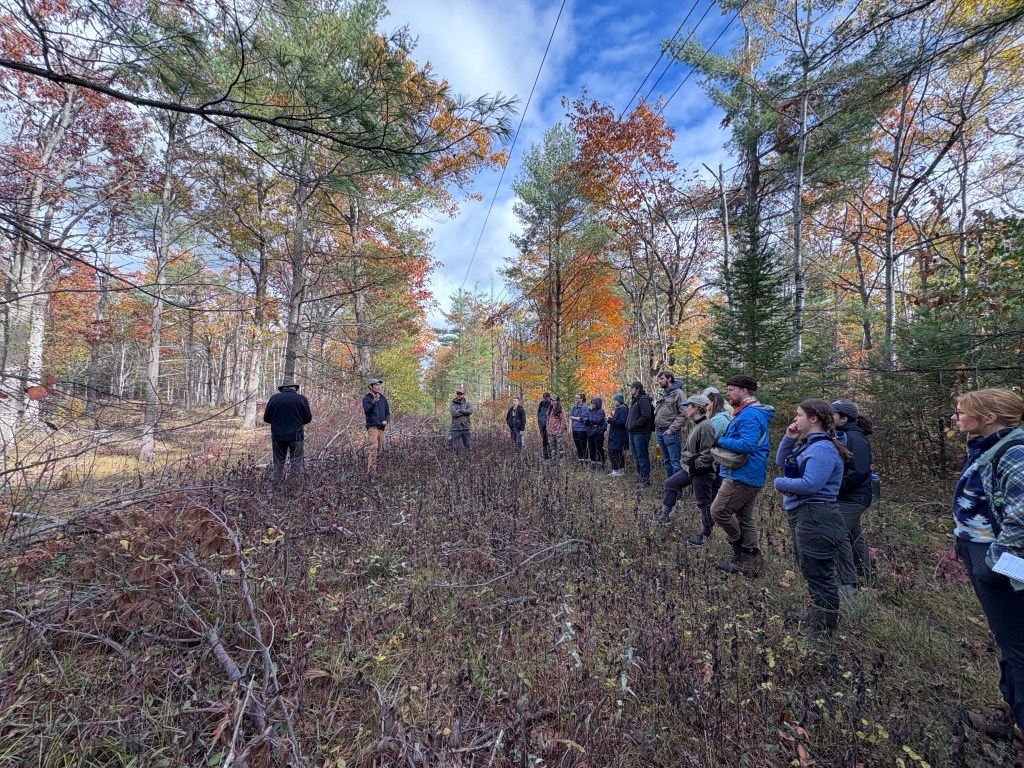
FIELD TRIPS
Field trip space is limited, registration is required. Carpooling can be arranged if needed. Register here!
10:00AM – 12:00PM, MORNING FIELD TRIPS
OPTION 1: Rare Charitable Research Reserve – Tom Woodcock, Jack Robinson, Brittany Killingbeck, Alissa Fraser. Cambridge, ON
The rare Habitat Corridor Project is an initiative to restore former agricultural lands in Cambridge Ontario. The total restoration area covers approximately 26 acres and will connect two remnant old-growth forests at rare’s Blair property along the Grand River. These old-growth remnants contain wetlands and historically supported breeding populations of Jefferson-complex salamanders. The two farm fields between the old-growth remnants have been gradually retired and transitioned to tallgrass prairie and meadow since 2009. Trees have been planted since 2014 to develop an 80 m wide corridor between the forest remnants. This project is supported in part by federal and provincial species at risk funding that will enable activities including construction of four new breeding ponds for Jefferson-complex salamanders, a snake hibernaculum, and pit and mound topography, along with additional tree and shrub planting. Join to learn more about this restoration project and rare’s broader work in conservation, research and education.
OPTION 2: Ignatius Jesuit Centre – Heather Lekx and Ashley Conrard. Guelph, ON
IJC is located immediately north of Guelph and our restoration work includes riparian, wetland, forest and meadow conservation through invasive removals and suppression, biotic resistance plantings, and a new phragmites biocontrol nurse site in partnership with rare.
We have piloted a community-based volunteer restoration program with methods that complement our organic agricultural operations on the 600 acre property.
2:00 – 4:30PM, AFTERNOON FIELD TRIP
Claire Schon and Rebecca Rooney – Waterloo Wetland Laboratory, Columbia Lake Environmental Reserve
Urban ecosystems are often overlooked yet workhorses, doing the heavy lifting for ecosystem services including carbon storage and improving water quality all while providing valuable habitat for many species. The University of Waterloos Columbia Lake Environmental Reserve is home to much urban ecology research. Columbia lake was redesigned in 2005 to improve water quality by reducing phosphorus loading in Laurel Creek. Since then, it has housed multiple research projects on water quality, climate change mitigation, invasive species management, and urban biodiversity.
This field trip, led by the Waterloo Wetland Laboratory, will feature some of this research work in action. Learn about the wetland restoration efforts conducted by the WWL. For over a decade, we have been studying the invasive plant, Phragmites australis. It is an incredibly tall invasive wetland plant, up to as tall as an adult male giraffe, and it towers over and shades native plants. Despite the negative effects to biodiversity, Phragmites control has received resistance in recent years as it is incredibly productive and sequesters carbon. Our recent research focuses on the potential climate change mitigation impacts of Phragmites control techniques. We will host a carbon flux demonstration to compare carbon acquisition within Phragmites and the adjacent meadow. During our field trip, we will also observe Phragmites biological control in action, seeing firsthand how the moth species which feed on and help control Phragmites, are working to suppress this invasive plant. You can learn how to identify the damage to Phragmites by the biocontrol agents in the field.
Come explore this urban workhorse ecosystem and observe the many plants and animals that call it home. We will walk over from campus to stroll through the many walking paths. There will be plenty of opportunities to learn about the site restoration and observe biodiversity (nearly 2000 species have been recorded on the property). According to eBird data, Columbia lake is the top birding hotspot in the Waterloo region in terms of all time species diversity (in addition to hosting a bird banding station!). It is a great stop-over site for a variety of migratory birds with open water, marshy shoreline, meadow and forest habitat. Each year it may host 15+ duck species, 10+ shorebird species, 10+ sparrow species and 20+ warbler species. Bring your binoculars as it is also common to spot several species of woodpeckers, swallows, herons and egrets, as well as Osprey and Bald Eagle. Join the Waterloo Wetland Lab on this field trip to explore the Waterloo campus from a whole new perspective!